The Cheapest Cars to Insure in America Right Now (2026 Updated List)
The Cheapest Cars to Insure in America Right Now (2026 Updated List)

You finally found the car you love. The color is perfect. The seats are comfortable. The price tag is almost reasonable.
Then you call your insurance company — and reality hits you like a cold bucket of water.
That "affordable" car? It's going to cost you $300 a month just to insure it. That's $3,600 a year. Gone. Every single year. Just so you can legally drive it.
Here's the thing nobody tells you at the dealership: the sticker price is only half the story. The car you choose determines your insurance bill for years to come. And most buyers don't think about this until it's too late.
This guide is here to change that.
Why Your Car Model Matters More Than You Think
Insurance companies are not guessing when they calculate your premium. They are running cold, hard numbers.
Rates vary by make and model based on specific factors — repair costs, safety ratings, theft rates, crash statistics, and engine performance — all of which help insurers estimate the likelihood and cost of future claims.
A sports car with 400 horsepower sends a very different signal to an underwriter than a family SUV with a five-star safety rating.
The cheapest cars to insure typically share three traits: high safety ratings, lower horsepower, and low theft rates. Simple as that. Insurers love boring. Boring means fewer claims. Fewer claims means lower premiums for you.
The Real Cost of Car Insurance in 2026
Before we get into the list, let's set the stage.
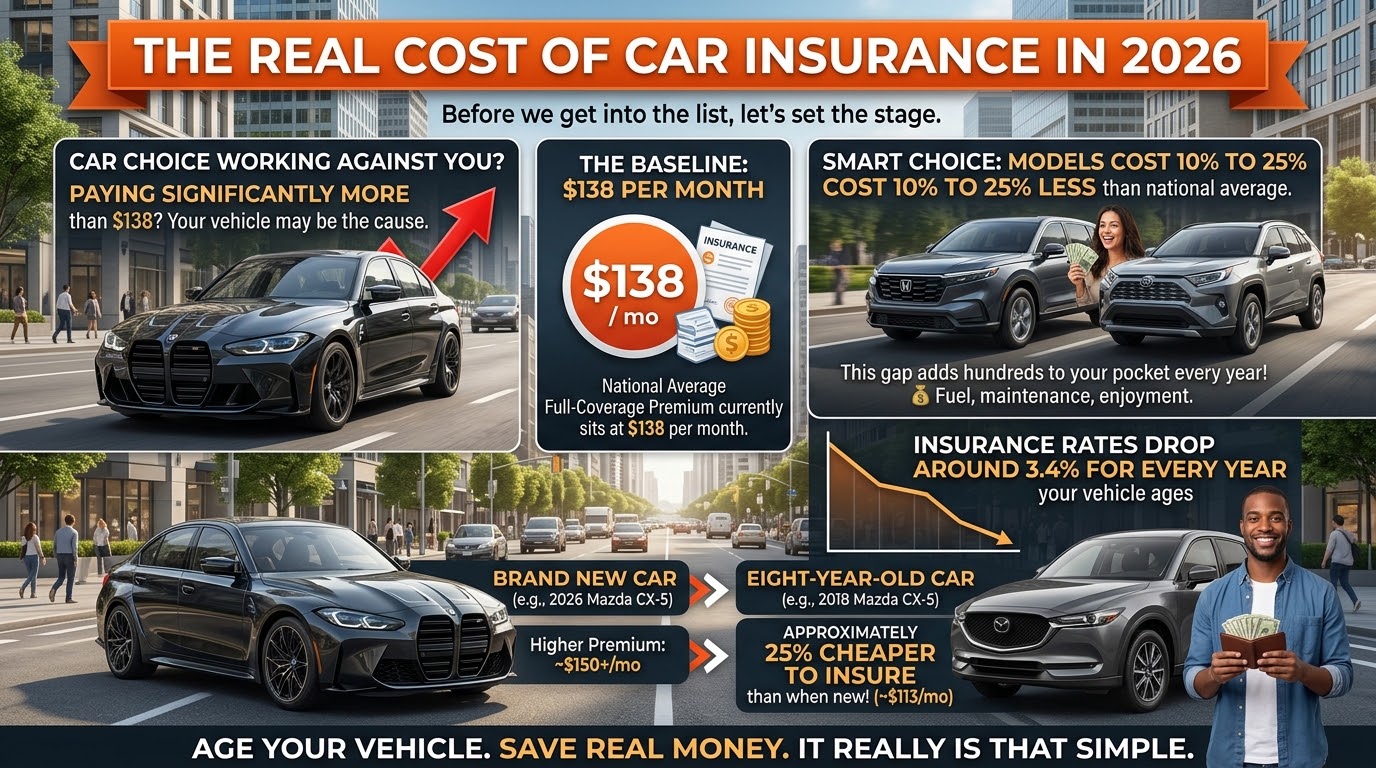
The national average full-coverage premium currently sits at $138 per month. That's the baseline. If you're paying significantly more than that, your car choice might be working against you.
The good news? Several models cost 10 to 25 percent less than that national average. That gap adds up to hundreds of dollars in your pocket every year — money that could go toward fuel, maintenance, or honestly, anything else you actually enjoy.
And here's something most buyers overlook entirely: insurance rates drop around 3.4 percent for every year your vehicle ages. An eight-year-old vehicle is approximately 25 percent cheaper to insure than when it's brand new.
Age your vehicle. Save real money. It really is that simple.
The 2026 Updated List: Cheapest Cars to Insure in America

Let's get into it. These are the vehicles that consistently top the rankings this year, across multiple major insurance data sources.
1. Honda CR-V — ~$161/month
The Honda CR-V is, by almost every measure, the king of cheap insurance in 2026.
Honda CR-V and Honda HR-V are tied for the lowest average insurance rates this year at $161 a month, with the CR-V coming in slightly cheaper at the annual level.
Insurance.com, Insure.com, and The Zebra all rank it at or near the top, with full coverage averaging $161 per month — roughly $1,932 per year.
Why is it so cheap to insure? Safety ratings, widely available parts, low repair costs, and a driver profile that insurers actually like. CR-V owners tend to be responsible. And that matters.
2. Buick Envista — ~$161/month
This one surprises people. A Buick? On a cheapest-to-insure list?
Yes, and it earns its spot.
The Envista is Buick's newest and most affordable model, starting under $25,000. It's small, light, modestly powered at 155 horsepower, and built on GM's global platform with widely available components.
USAA offers rates as low as $124 per month for this model — which is remarkably low for a brand-new vehicle in 2026.
It carries Buick's surprisingly strong safety reputation without the repair costs associated with premium German brands. The Envista is proof that you don't need to sacrifice quality to save money.
3. Subaru Crosstrek — ~$2,299/year
The Subaru Crosstrek tops CarInsurance.com's data study as the single cheapest vehicle to insure annually, at $2,299 per year for full coverage.
That's roughly $192 per month — but this is full, comprehensive coverage in areas where rates skew high. For many drivers in mid-cost states, real-world quotes come in even lower.
The Crosstrek's secret? Standard all-wheel drive, strong crash ratings, and the kind of price tag that doesn't make insurers nervous about replacement costs.
4. Subaru Forester — ~$166/month
Subaru Forester drivers pay about $166 per month for insurance on average. Nationwide offers the most affordable option, averaging around $126 per month.
The Forester is one of those vehicles that quietly does everything right. Strong IIHS ratings. Practical body style. Nobody is stealing it at 2 AM. That combination keeps premiums low year after year.
5. Subaru Outback — ~$163/month
The Subaru Outback averages around $163 per month for coverage. American Family offers the lowest rates for this model, at about $107 per month.
If you need space for weekend adventures but don't want to pay weekend-warrior insurance prices, the Outback is one of the smartest choices on the market right now.
6. Volkswagen Taos — ~$163/month
Insurance for the Volkswagen Taos averages about $163 per month, making it one of the cheapest compact SUVs to insure this year. Progressive averages roughly $107 per month for this model.
The Taos often flies under the radar compared to the Tiguan or the Jetta, but for insurance purposes, that's actually a feature — not a bug.
7. Subaru Impreza — Standout Sedan Value
Not everyone wants an SUV. If you're a sedan person, the Impreza is your answer.
The Impreza saves drivers approximately 63 percent compared to the national average sedan insurance cost, which makes it the standout value in its segment. Standard all-wheel drive, strong crash-test performance, and a starting price under $24,000 all contribute to its low premiums.
The Impreza doesn't generate excitement in parking lots, car forums, or theft statistics — and that trifecta of anonymity is exactly what makes it cheap to insure.
That last line should be framed on your wall if you care about saving money.
The Subaru Effect: One Brand Dominates

Stop and notice something. Subaru appears on this list over and over again.
That's not a coincidence.
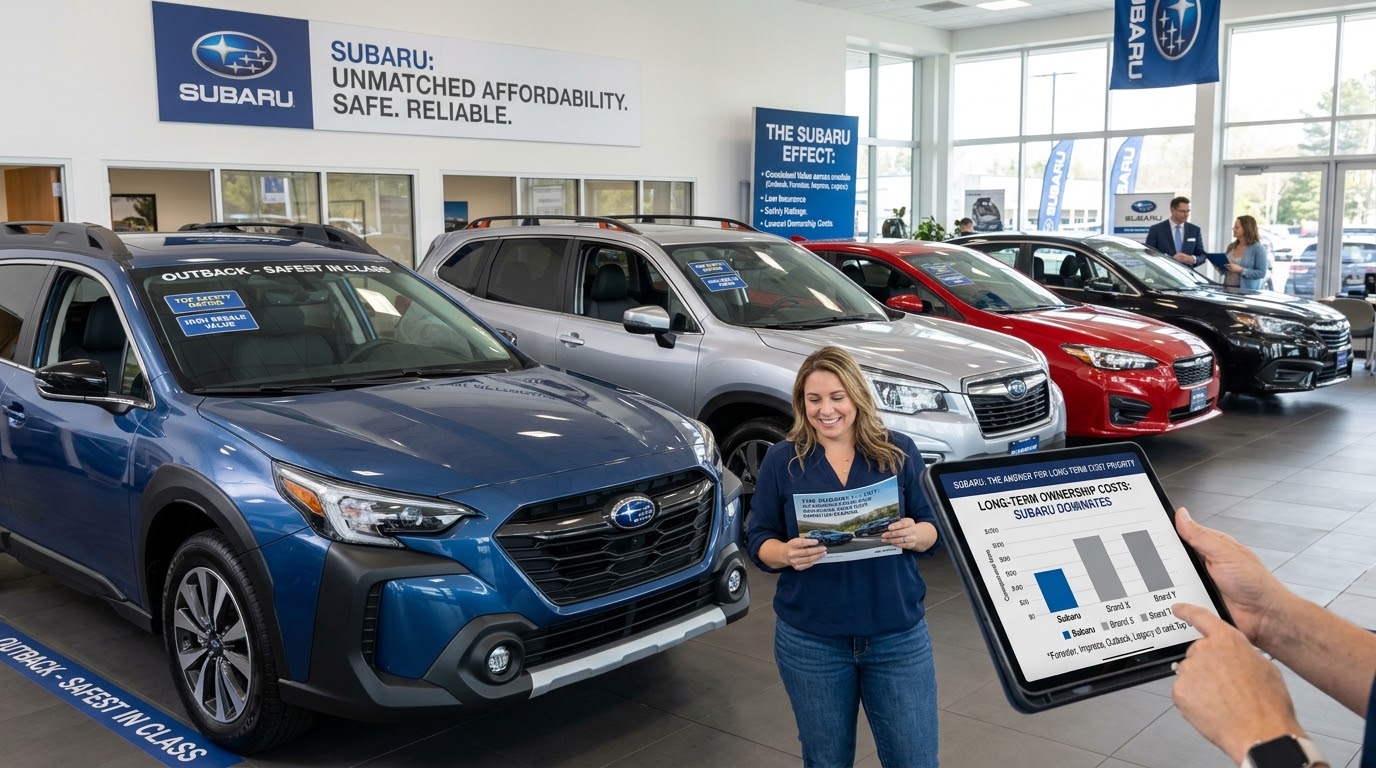
Subaru produces the most consistently affordable models across the dataset. The Forester, Impreza, Outback and Legacy all rank near the top of their respective categories. Subaru's combination of safety ratings and low theft rates gives it a pricing advantage that holds up across coverage levels.
If you walk into any dealership without a brand preference, and your priority is long-term ownership cost, Subaru is the answer you've been looking for.
What About Electric Vehicles?

A lot of buyers assume EVs are automatically more expensive to insure. That used to be true. Not anymore.
All five major EV models in MoneyGeek's 2026 dataset fall within a $17 annual range. Two years ago, electric vehicles carried a meaningful premium over gas-powered vehicles. The 2026 data shows that gap has largely closed, with EVs now averaging around $1,600 annually — nearly identical to gas-powered sedans.
The EV insurance market has normalized. If you're going electric, carrier choice now matters far more than model choice. Get at least three quotes before you assume anything.
The Expensive Side of the Spectrum (What to Avoid)

It helps to know what not to buy, too.
The most expensive vehicles to insure in 2026 include the BMW M8 Gran Coupe at $6,744 per year, the BMW M5 Touring at $6,708, and the BMW M5 at $6,593. These vehicles cost more to insure due to high-performance engines, expensive parts, higher theft rates, and costly collision claims.
That's over $500 per month. Just for insurance. Before gas, maintenance, or a single car payment.
The vehicle you drive is a financial decision that compounds every month. Choose accordingly.
5 Smart Tips to Lower Your Insurance Premium Even Further

Getting a naturally cheap-to-insure vehicle is step one. Here's how to push the bill even lower.
Shop multiple carriers. Rates can vary by 30 to 50 percent for the exact same driver and vehicle. Never settle for one quote.
Consider a used model. Both the MSRP and insurance premiums decrease over time. Purchasing a used car is one of the easiest ways to get cheap car insurance.
Bundle your policies. Home and auto bundling typically saves 10 to 25 percent with most major carriers.
Raise your deductible. If you have a solid emergency fund, increasing your deductible from $500 to $1,000 can meaningfully reduce your monthly premium.
Maintain a clean record. Your driving history is one of the biggest variables in your rate. One at-fault accident can undo years of savings overnight.
Conclusion: The Right Car Is a Financial Strategy

Buying a car isn't just about what you drive off the lot. It's about what you pay every single month for the next five, six, or seven years.
Comparing insurance quotes before buying and choosing a slightly older model can significantly reduce premiums. That one step — done before you sign anything — could save you thousands.
The vehicles on this list share a quiet, unglamorous superpower: they cost less to own in the long run. The Honda CR-V. The Subaru lineup. The Buick Envista. None of them will turn heads at a stoplight. But they will keep more money in your bank account, month after month, year after year.
And in the real world? That matters a lot more than horsepower.
Before your next purchase, run the insurance quote first. Not after. Not during financing. Before. That one habit separates smart car buyers from everyone else.
Data sourced from The Zebra, Insurance.com, CarInsurance.com, MoneyGeek, and Autoblog (2026 rate analyses). Rates are averages and vary by driver profile, location, and coverage level. Always compare multiple quotes from licensed insurers before making a decision.

Comments
Post a Comment
Silahkan anda berkomentar dengan baik, jangan melakukan Spam, jangan menyisipkan link aktif,
terima kasih.